
Three Types of Round Concrete Formwork
The three types of round concrete formworks have their own unique advantages and inherent limitations, corresponding to completely different engineering application scenarios.
6/19/20263 min read
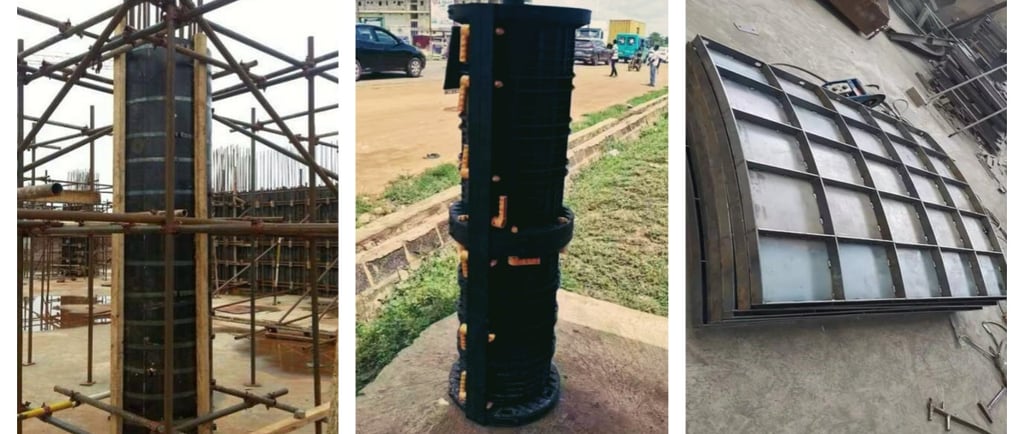
Round concrete formwork is an indispensable building material for constructing circular concrete structures such as building columns, bridge piers and municipal cylindrical components. In modern construction projects, different engineering scales, construction cycles, design standards and budget plans require matching formwork materials. At present, there are three mainstream types of round concrete formworks widely used in the construction industry: wooden round formwork, plastic round formwork, and steel round formwork. Each category has unique structural properties, usage limits and applicable scenarios. This article systematically sorts out the advantages and disadvantages of the three formworks to provide clear reference standards for engineering selection.
1. Wooden Round Concrete Formwork
Wooden round formwork is a traditional and highly flexible forming material for circular concrete structures, mainly applied to short-term engineering and non-standard customized column construction.
Advantages
First, it supports full-size free customization. It can be tailor-made according to any special diameter, height and arc design requirements, perfectly solving the forming problem of non-standard special-shaped circular columns that standard formwork cannot adapt to. Second, the initial procurement cost is low, with no redundant investment risk, which is very cost-effective for temporary construction and one-time pouring projects. Third, the wooden formwork is light in weight and easy to cut and splice on site. It relies entirely on manual operation without large mechanical equipment, greatly improving the construction flexibility of small-batch special projects.
Disadvantages
The most obvious shortcoming is thelow turnover frequency, with a reusable service life of only about 8 times under standard construction and maintenance conditions. In addition, wood materials are prone to water absorption, swelling and deformation in humid outdoor environments, which easily causes mortar leakage during concrete pouring and leads to rough wall surfaces. Subsequent manual trimming and repairing are required, increasing auxiliary construction workload. Moreover, its structural strength is limited, and it cannot bear high concrete pouring pressure, so it is not suitable for large-scale, high-load and long-cycle engineering projects.
2. Plastic Round Concrete Formwork
Plastic round formwork is a new environmentally friendly and reusable building material, specially developed for standardized small and medium-sized circular column engineering, and is the most cost-effective choice for medium-term repetitive construction projects.
Advantages
It has an excellent recycling capacity with a turnover rate of up to 100 times, which greatly reduces the comprehensive material cost of the project compared with wooden formwork. The whole formwork is lightweight, realizing fully manual assembly, fixing and demolding without crane or mechanical assistance, saving a lot of labor costs and shortening the construction period. The compact and smooth surface effectively avoids slurry leakage, bulging and deformation problems. The poured concrete column has a flat and delicate surface with high molding accuracy, basically eliminating secondary trimming work. It is highly matched with standardized small column construction of medium-sized municipal and civil engineering projects.
Disadvantages
This formwork adopts fixed unified specifications with no customizable size. It only has four standard sizes: diameters of 300mm, 350mm, 400mm, 450mm and a unified height of 750mm. The single and fixed specifications make it only applicable to conventional small and medium-sized circular columns. It cannot meet the construction requirements of large-diameter columns, ultra-high columns and various non-standard special-shaped circular structures, resulting in a relatively single application scenario and poor versatility for special engineering projects.
3. Steel Round Concrete Formwork
Steel round formwork is a high-strength, super-durable professional forming material, positioned for large-scale, high-standard and long-cycle engineering construction, and is the preferred formwork for high-precision circular concrete structure pouring.
Advantages
It supports arbitrary full-size customization with no restrictions on diameter and height, which can meet the construction needs of various large-diameter columns, super-high bridge piers and special large circular concrete structures. Made of high-quality steel, it has ultra-high structural strength and overall rigidity, no deformation or expansion under high concrete pouring pressure, ensuring accurate structural size and smooth and neat concrete surface. It has excellent weather resistance, corrosion resistance and impact resistance, with an extremely long service life and unlimited repeated turnover use in conventional construction environments, bringing the best long-term cost performance for large construction enterprises and long-cycle projects.
Disadvantages
Due to the high-density metal material, the steel formwork is heavy in weight and cannot be installed or disassembled manually. It must be equipped with cranes and other mechanical equipment for construction, which increases equipment investment and on-site construction costs. Meanwhile, its one-time purchase cost is much higher than wood and plastic formworks. It is not economical for short-term projects, small-batch temporary construction and low-budget engineering, and has higher requirements for on-site construction conditions and equipment matching.
Conclusion
The three types of round concrete formworks have their own unique advantages and inherent limitations, corresponding to completely different engineering application scenarios. Wooden round formwork features flexible customization and low initial cost but low turnover times, suitable for short-term, small-batch and non-standard customized projects. Standard plastic round formwork is lightweight, labor-saving and highly reusable with stable quality, ideal for medium-sized conventional projects and standardized small circular column construction. Steel round formwork has high strength and full customization capability but requires mechanical operation with high initial investment, perfectly matching large-scale, high-standard and long-cycle engineering projects. Reasonable formwork selection based on actual project conditions can effectively balance construction quality, construction efficiency and project budget.